 English
  日本語
日本語  한국어
한국어  français
  Deutsch
  Español
  italiano
  русский
  português
  Türkçe
  العربية
What are you looking for?

Fiber laser refers to a laser that uses rare earth element-doped glass fiber as a gain medium. Fiber laser can be developed on the basis of fiber amplifier: under the action of pump light, it is easy to form high power density in the fiber, resulting in the laser working substance of the laser. The energy level is "number inversion", and the laser oscillation output can be formed when a positive feedback loop (constituting a resonant cavity) is properly added.
Today, as industrial processing requirements become more diverse and demanding, the laser source—the heart of a laser cutting or marking machine—has evolved into both single-mode and multi-mode configurations. Fiber lasers are widely used across various fields such as optical communication, space telecommunication, shipbuilding, automobile manufacturing, laser engraving, laser marking, metal and non-metal cutting and welding, defense, and medical equipment.
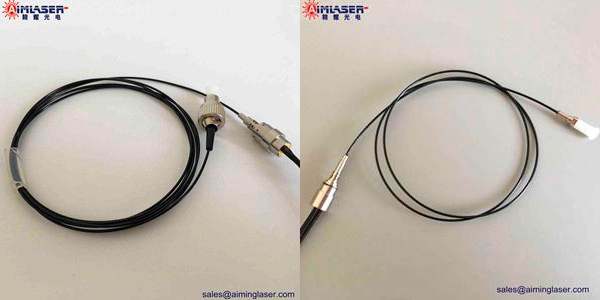
It is well known that the energy distribution of the beam excited by the fiber laser is similar to the "Gaussian distribution". The principle and structure of the fiber laser are composed of a pump source, a multimode coupler (beam combiner), a fiber grating, an active fiber, and a beam calibration output module. And passive fiber (energy output fiber) and other components. Among these, high-performance fiber coupled laser diode modules are often used as reliable pump sources to drive rare-earth doped fibers, ensuring stable output and high beam quality.
Aiming's fiber coupled laser module offers excellent coupling efficiency and modular design, making it ideal for fiber laser integration in both single-mode and multi-mode configurations.
When there is only one pump module inside the laser, it is called a single-mode laser, and multiple pump modules are combined together to allow multiple pump beams to enter the active fiber through a beam combiner, so that higher power can be obtained. The laser beam of this multi-module combination is a multi-mode laser.
Therefore, among the mainstream fiber laser products, single-mode lasers are mostly medium and small power, while high-power products are mostly multi-mode lasers.
The core of a single-mode fiber is relatively small and emits a clean Gaussian beam with high energy concentration—similar to a sharp mountain peak. This results in superior beam quality and precision.
In contrast, a multi-mode fiber combines several Gaussian beams, producing an energy distribution more like an inverted bowl—broader but less concentrated. The beam quality is lower, but it allows for higher power and greater thermal stability.
Accordingly, the two types serve different purposes:
Single-mode lasers excel at fine, precise cutting or micro-processing of thin materials (e.g., stainless steel or carbon steel sheets ≤1 mm).
Multi-mode lasers perform better for thick-plate cutting (≥2 mm), where higher power and uniform energy distribution are needed.
In such scenarios, a single mode laser diode module is often used as a stable and narrow-linewidth seed source for precision work, while a multimode laser diode is preferred for high-power, high-throughput operations due to its broader beam distribution and thermal tolerance.
From a power perspective:
Lasers below 1000 W are mainly used for thin-plate processing, where single-mode configurations offer cleaner cuts and higher precision.
Lasers above 1 kW are typically multi-mode, balancing both thin and thick material cutting with better durability.
From a manufacturing standpoint, improving processing quality is a non-negotiable trend. However, single-mode fibers have thinner cores, which means they bear a higher optical load for the same output power—testing the material’s damage threshold.
When cutting highly reflective materials, back-reflection can overlap with emitted light. If the fiber material lacks sufficient tolerance, it may damage or even burn the fiber core. Hence, many high-power industrial fiber lasers still use multi-mode configurations for improved robustness and longer service life.
To meet the needs of both precision and power applications, AIMINGLASER offers a wide range of single-mode and multi-mode fiber-coupled laser diode modules, customizable by wavelength and power level.
All AIMINGLASER fiber-coupled laser modules are designed for:
High coupling efficiency
Stable wavelength performance
Customizable connectors (FC, SMA, etc.)
CW/TTL/Analog modulation compatibility
Both single-mode and multi-mode fiber lasers play vital roles in modern laser systems.
Single-mode excels in precision, stability, and fine cutting.
Multi-mode dominates high-power, large-area, and heavy-duty processing.
Whether for fiber laser integration, industrial manufacturing, or research applications, AIMINGLASER provides professional fiber-coupled laser solutions to meet diverse wavelength, power, and modulation requirements.