
Views: 267 Author: AimLaser Publish Time: 2026-08-15 Origin: Site


Content Menu
● Why China for Single Line Lasers
>> 1. AIMING LASER TECHNOLOGY CO., LTD.
>> 2. Elite Optoelectronics Co., Ltd.
>> 3. Changchun New Industries Optoelectronics Technology Co., Ltd. (CNI)
>> 4. MXTLASER Technology Corporation
>> 5. Han's Laser Technology Industry Group
>> 6. Wuhan Raycus Fiber Laser Technologies Co., Ltd.
>> 8. JPT Opto-electronics Co., Ltd.
>> 9. Shenzhen JNJ Optoelectronics Technology Co., Ltd.
● Supplier Comparison: Capacity, MOQ, and Compliance
>> Choose the right optical design
>> Key specifications to define
>> 1. Confusing a cylindrical line with a uniform Powell line
>> 2. Quoting line width without test distance
>> 3. Buying by milliwatt alone
>> 4. Accepting non-specific certificates
>> 5. Ignoring batch-to-batch diode variation
● Internal Procurement Insight
>> Step 1: Check legal identity
>> Step 2: Verify quality certificates
>> Step 3: Conduct a live video audit
>> Step 4: Order samples correctly
>> Step 5: Lock the specification before mass production
● FAQ
>> 1. How can I verify whether an ISO certificate has expired?
>> 2. Does CE certification automatically mean a Single Line Laser is legal to sell in Europe?
>> 3. What sample test should a buyer require for a Powell-lens line laser?
>> 4. How should I set MOQ for a custom OEM line laser module?
>> 5. How can I prevent a supplier from changing laser diodes after approval?
China is a major sourcing base for Single Line Laser modules used in machine vision, 3D measurement, alignment, inspection, positioning, automation equipment, and scientific instruments. For procurement teams, however, choosing a supplier is not simply about comparing wavelength, output power, and price. The real differentiators are beam consistency, optical-mechanical integration capability, documentation traceability, batch stability, and the supplier's ability to support OEM changes without disrupting delivery.
This guide is designed for brand owners, importers, industrial distributors, and equipment manufacturers looking for long-term Chinese partners—not merely a low-cost sample supplier. China's broader machinery and electrical-equipment exports continue to be substantial, while established optics ecosystems in Xi'an, Wuhan, Shenzhen, Changchun, and the Yangtze River Delta provide buyers with access to laser diodes, lenses, precision machining, electronics, and system-integration resources.

We assessed manufacturers using procurement-relevant factors rather than marketing claims alone:
- Product suitability: Ability to supply line laser modules, laser line generators, structured-light lasers, or related diode-laser solutions for industrial use.
- Optical engineering: Capability in wavelength selection, line thickness, fan angle, beam uniformity, focus distance, lens configuration, and output stability.
- OEM/ODM depth: Flexibility in housing dimensions, cable/connector configuration, modulation, labeling, packaging, and application-specific optical design.
- Quality controls: Evidence of incoming inspection, module assembly processes, optical alignment, aging/burn-in, electrical testing, and environmental testing.
- Compliance readiness: Availability of relevant documentation such as CE, RoHS, IEC 60825-related laser safety information, and ISO-based quality-system evidence where applicable.
- Commercial reliability: Response quality, sample process, engineering communication, MOQ flexibility, export experience, and production scalability.
- Application fit: Whether the supplier is geared toward machine vision, laboratory equipment, industrial integration, high-volume electronics, or specialist laser systems.
A line laser module should not be judged by optical power alone. In vision and measurement applications, line uniformity, divergence, line straightness, thermal drift, and mechanical repeatability often have greater impact on end-equipment performance.
China has several relevant industrial clusters rather than one single "laser manufacturing city":
| Cluster | Typical strengths | Suitable sourcing needs |
|---|---|---|
| Xi'an | Diode laser modules, optics, research-linked engineering, customized industrial modules | Machine vision, alignment, OEM optical modules |
| Wuhan Optics Valley | Photonics, industrial lasers, optical research, laser systems | Advanced laser sourcing and system-level applications |
| Shenzhen / Guangdong | Electronics supply chain, drivers, cables, housings, high-volume assembly | Cost-sensitive and scalable electronics integration |
| Changchun | Optics, scientific instruments, solid-state laser development | Research, laboratory, imaging, precision applications |
| Yangtze River Delta | Precision manufacturing, automation, sensors, export-oriented supply chains | Industrial equipment and automation projects |
Wuhan's "Optics Valley" is widely recognized as a major Chinese optics and photonics ecosystem, supported by university, research, and industrial resources. For global buyers, the advantage of sourcing from China is therefore not only unit cost; it is access to a vertically connected supply chain for laser diodes, optics, drivers, metal housings, cables, labels, and final assembly.
| Manufacturer | Founded | Primary focus | OEM/ODM suitability | Typical buyer fit |
|---|---|---|---|---|
| AIMING LASER TECHNOLOGY CO., LTD. | 2012 | Diode laser modules, line lasers, Powell-lens uniform line lasers | High | Small-to-mid-sized brands and industrial OEMs |
| Elite Optoelectronics Co., Ltd. | Not publicly confirmed in reviewed source | Uniform line lasers, custom laser solutions | High | Machine vision and measurement projects |
| Changchun New Industries Optoelectronics Technology Co., Ltd. (CNI) | 1996 | Solid-state and diode laser systems | Medium to high | Scientific, industrial, instrumentation OEMs |
| MXTLASER Technology Corporation | 2012 | Laser-based light sources and custom laser modules | High | Compliance-focused OEM projects |
| Han's Laser Technology Industry Group | 1996 | Industrial laser equipment and broader laser solutions | Project dependent | Industrial-equipment integrators |
| Wuhan Raycus Fiber Laser Technologies | 2007 | Fiber laser sources and industrial laser products | Project dependent | Industrial processing systems |
| Maxphotonics Co., Ltd. | Not publicly confirmed in reviewed source | Fiber lasers, laser components, industrial systems | Project dependent | High-power industrial applications |
| JPT Opto-electronics Co., Ltd. | 2006 | Laser sources and MOPA fiber-laser technology | Project dependent | Advanced industrial laser equipment |
| Shenzhen JNJ Optoelectronics Technology Co., Ltd. | Not publicly confirmed in reviewed source | Laser diodes and standard laser modules | Medium | Cost-sensitive standard modules |
| Laserland | Not publicly confirmed in reviewed source | Laser modules, diodes, optics, customization | Medium | Prototyping, distribution, diversified module sourcing |
AIMING LASER TECHNOLOGY CO., LTD. (AimLaser) is a practical option for buyers seeking customized diode laser modules without the rigidity often associated with large industrial-laser groups. Founded in 2012, the company manufactures solid-state lasers and diode laser modules for OEM instrument applications, with product wavelengths from 405 nm to 980 nm and output power from 0.4 mW to 6,000 mW. Its portfolio includes dot lasers, line lasers, cross-line lasers, Powell-lens uniform line laser modules, fiber-coupled products, laser line generators, and beam expanders.
For machine-vision projects, AimLaser is particularly relevant because it offers Powell-lens uniform line laser modules designed for compact dimensions, narrow line width, adjustable fan angles from 10° to 90°, and wavelengths from 405 nm to 850 nm. The company states that its thinnest line can reach 10 μm under specified conditions; buyers should verify this against their own working distance, sensor setup, and optical environment during sample validation.
Core strengths
- Broad range of diode laser module configurations for OEM instruments.
- Strong relevance to machine vision, alignment, inspection, positioning, and structured-light requirements.
- Flexible support for wavelength, housing, output power, fan angle, cable, connector, and labeling customization.
- Suitable for smaller and mid-sized international brands that need faster engineering communication and lower-volume customization.
- Publicly shown assembly, beam inspection, fiber processing, high/low-temperature, vibration, and aging-test capabilities.
Best for
- Buyers requiring a Single Line Laser tailored to a vision system rather than an off-the-shelf pointer module.
- OEM brands that need private labeling, custom housing, or application-specific beam geometry.
- Companies that need a supplier willing to support sample iteration before a larger production release.
Buyer verification point
Ask AimLaser to define the measurement conditions behind requested parameters: working distance, ambient temperature, duty cycle, line width measurement method, fan angle, and optical-power tolerance. A "10 μm line" claim is only meaningful when these conditions are stated in the specification and test report.

Elite Optoelectronics focuses on customized laser solutions for machine vision and measurement. Its published Powell-lens uniform line laser range covers wavelengths from 405 nm to 850 nm, output power up to 400 mW, and emphasizes uniform line width and intensity.
Core strengths
- Relevant product positioning for machine vision and measurement.
- Focus on uniform-line output using Powell-lens optics.
- Custom laser product and OEM service offering.
- Suitable when a buyer prioritizes line uniformity over a simple cylindrical-lens line projection.
Best for
- 3D triangulation and profiling.
- Surface inspection.
- Vision-guided automation.
- Measurement equipment requiring a more consistent light distribution across the projected line.
CNI was founded in 1996 and manufactures solid-state and diode laser systems for scientific, industrial, instrumentation, and OEM applications. The company states that selected products and systems are associated with ISO 9001, FDA, CE, RoHS, and JQA certifications.
Core strengths
- Long operating history in scientific and industrial laser markets.
- Broad technical coverage across diode lasers, solid-state lasers, laboratory systems, and instrumentation.
- Strong fit for buyers who require more than a basic line module, such as stable laser sources for imaging, spectroscopy, holography, or research equipment.
Best for
- Scientific instrumentation.
- Higher-specification industrial projects.
- OEMs seeking lasers with broader technical documentation requirements.
Buyer verification point
Confirm whether the certification applies to the factory quality-management system, a specific product family, or the exact module being purchased. A supplier's general certification statement should not be treated as product-specific compliance evidence.
MXTLASER states that it was established in 2012 and specializes in laser-based light sources, independent development, and systematized manufacturing. It publicly states ISO 9001, FDA, IEC 60825, CE, and RoHS-related compliance credentials.
Core strengths
- Compliance-oriented product positioning.
- Suitable for OEM buyers needing more structured documentation during supplier qualification.
- Potentially relevant for laser-source projects requiring custom light-source design.
Best for
- Exporters selling into compliance-sensitive markets.
- OEM product teams that need to establish a documented technical file.
- Buyers requiring laser safety documentation from early sample stages.
Han's Laser is one of China's larger laser-industry groups and is generally associated with industrial laser equipment, automation, and broader laser technologies. Its scale can be valuable for industrial system integrators, although buyers specifically seeking compact single line laser modules should confirm whether their project fits the company's preferred product and order profile.
Core strengths
- Large industrial-laser ecosystem.
- Stronger fit for equipment-level and industrial automation projects.
- Potential access to integrated laser-processing and automation resources.
Best for
- Buyers building industrial equipment rather than sourcing a low-MOQ optical module.
- Projects involving laser systems, automation platforms, or industrial processing.
Raycus is known primarily for fiber laser sources and industrial laser products. It is more relevant to high-power industrial laser applications than to small machine-vision line-laser modules, but it can be considered by buyers whose project scope includes broader laser-source integration.
Core strengths
- Strong alignment with industrial laser-source applications.
- Wuhan location offers proximity to a major photonics cluster.
- Better fit for industrial-scale laser equipment than basic low-power line modules.
Best for
- Laser-processing equipment manufacturers.
- Buyers integrating fiber-laser technologies.
- High-power industrial applications.
Maxphotonics is a Chinese laser component and system supplier associated with diode bars, pump modules, and fiber lasers for industrial applications. Its strongest relevance is generally industrial laser equipment rather than compact line-laser sourcing.
Core strengths
- Industrial laser-source orientation.
- Potential relevance for advanced OEMs purchasing higher-power laser components.
- Suitable for projects that may scale from component sourcing toward equipment integration.
Best for
- Industrial laser-processing equipment.
- Fiber-laser or pump-source supply chains.
- Buyers with substantial technical integration capability.
JPT is associated with laser-source development, especially MOPA fiber-laser technology. Like Raycus and Maxphotonics, it is not a direct substitute for every low-power Single Line Laser supplier, but it is relevant for sophisticated industrial laser projects where source control and pulse characteristics matter.
Core strengths
- More advanced laser-source positioning.
- Stronger fit for industrial marking, processing, and specialized equipment.
- Potential value for OEMs requiring application-specific pulse control.
Best for
- Industrial laser-system developers.
- Marking, engraving, and precision-processing applications.
- Buyers whose requirements exceed conventional visible line-laser modules.
Shenzhen suppliers are frequently valuable for buyers needing standard laser diode modules, electronics integration, and scalable assembly. Shenzhen JNJ Optoelectronics is referenced as a high-volume, ISO 9001-oriented supplier for standard TO-package red and blue diode products.
Core strengths
- Potential high-volume electronics and diode-module support.
- Shenzhen supply-chain access for drivers, connectors, cables, compact housings, and rapid component sourcing.
- Suitable for projects using relatively standard optical and electrical configurations.
Best for
- Standard red or blue diode modules.
- Larger-volume procurement.
- Buyers with in-house optical engineering who can specify the exact module configuration.
Laserland offers diode-module customization involving wavelength, housing dimensions, and optics, alongside an established catalog of laser modules, diodes, optics, and laser-safety products.
Core strengths
- Flexible product breadth.
- Useful for prototyping, replacement parts, product testing, and diversified module sourcing.
- Offers customization in wavelength, mechanical design, and optics.
Best for
- Early-stage prototyping.
- Distributors handling a broad module catalog.
- Buyers requiring a mix of laser modules, diodes, lenses, and protective products.
Exact capacity and MOQ figures are often confidential, product-specific, and affected by wavelength, housing, lens type, and custom-engineering workload. Buyers should treat supplier-reported numbers as quote-stage data and request a written confirmation for the exact SKU.
| Manufacturer | Capacity profile | MOQ tendency | Compliance/documentation to request |
|---|---|---|---|
| AIMING LASER | Flexible OEM module production; suitable for sample-to-batch scaling | Usually more flexible for customized projects | ISO certificate, RoHS declaration, CE/IEC documentation where applicable, aging and optical test report |
| Elite Optoelectronics | Custom, project-based line-laser production | Project dependent | Optical specification, uniformity test method, CE/RoHS evidence if required |
| CNI | Broad scientific and industrial laser production | Often project dependent | ISO 9001, CE, RoHS, FDA/JQA scope and product-specific certificates |
| MXTLASER | Laser light-source and custom module production | Project dependent | ISO 9001, IEC 60825, CE, RoHS, FDA-related documentation |
| Han's Laser | Large industrial equipment capacity | Often better for larger projects | System-level certification and technical file |
| Raycus | Industrial laser-source capacity | Usually project/volume dependent | Product-specific technical and safety documentation |
| Maxphotonics | Industrial laser and source capacity | Usually project/volume dependent | Product-specific technical and compliance documents |
| JPT | Industrial laser-source capacity | Usually project dependent | Source specification, safety documentation, application validation |
| Shenzhen JNJ | Standard diode/module-oriented supply | Often more volume-oriented | ISO scope, diode binning and batch-control records |
| Laserland | Catalog plus custom module supply | Often flexible for standard items | Product specification, laser class, CE/RoHS evidence if applicable |
Do not accept "CE available" as a complete answer. Ask for the exact Declaration of Conformity, product model number, applicable directive or regulation, signatory details, date, and supporting test-report reference.
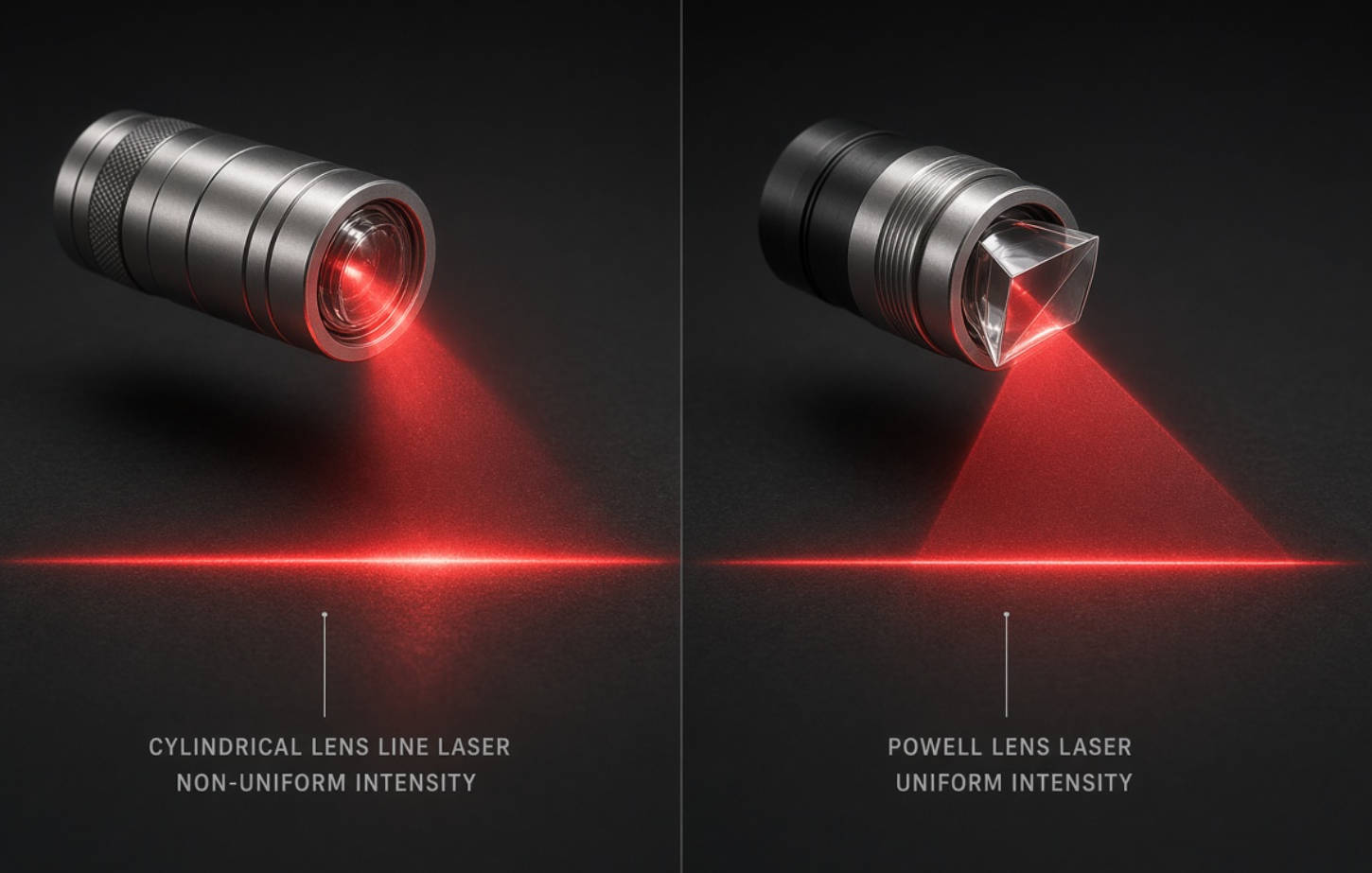
A conventional line laser often uses a cylindrical lens to spread a beam into a line. This is suitable for many alignment and basic positioning tasks. A Powell lens, by contrast, is designed to redistribute the laser beam into a straighter line with more uniform power distribution, which is especially valuable in machine vision and 3D triangulation.
| Requirement | Typical recommendation |
|---|---|
| Basic alignment or positioning | Standard line laser with cylindrical lens |
| Machine vision edge detection | Narrow-line laser with controlled focus and stable output |
| 3D profiling or triangulation | Powell-lens uniform line laser |
| Long working distance | Verify divergence, line thickness, and optical power at actual distance |
| Reflective metal inspection | Test with target material; consider wavelength, exposure, and polarization strategy |
| Outdoor or high-ambient-light use | Evaluate output power, wavelength, optical filtering, and safety classification |
Before requesting quotations, provide the supplier with a controlled technical specification:
- Wavelength, such as 405 nm, 450 nm, 520 nm, 635 nm, 650 nm, 780 nm, 808 nm, or 850 nm.
- Optical output power at the module aperture.
- Working distance and depth of field.
- Fan angle, such as 10°, 30°, 45°, 60°, 90°, or customized.
- Required line width at a defined working distance.
- Uniformity target across the line.
- Beam straightness and line-intensity acceptance criteria.
- Laser class and safety requirements under IEC 60825-1.
- Input voltage, current consumption, modulation requirements, cable length, connector type, and pinout.
- Housing size, material, mounting threads, heat dissipation, ingress-protection expectations, and operating temperature.
- Application environment, including vibration, dust, reflective surfaces, ambient lighting, duty cycle, and required operating hours.
Many suppliers describe any projected line as a "uniform line laser." In reality, a simple cylindrical lens may create a visibly brighter center and weaker ends. If your camera algorithm depends on stable intensity across the field of view, require a line-uniformity test rather than accepting product photos.
How to avoid it: Ask for a beam-profile image, measurement method, sampling distance, camera settings, exposure conditions, and numerical uniformity data.
A supplier may state "thin line," "fine line," or "10 μm line" without specifying working distance. Line width naturally changes with distance, lens focus, diode divergence, and mechanical alignment.
How to avoid it: State the acceptance condition in this format:
"Line width ≤ X μm at Y mm working distance, measured on Z target material at stated exposure and ambient conditions."
Higher output power does not automatically improve machine-vision performance. Excessive power can saturate the camera sensor, increase speckle, create reflections, trigger safety restrictions, and generate heat-management problems.
How to avoid it: Test laser, lens, camera, filter, target material, exposure time, and ambient light as one system.
A supplier may provide an ISO certificate issued to a different legal entity, a CE document that does not cover the quoted model, or a RoHS report for an unrelated product family.
How to avoid it: Verify the legal company name, registered address, scope, certificate number, issue date, expiry date, certification body, and exact model coverage.
This is an important but under-discussed risk. Even when modules have the same nominal wavelength and output power, diode lots can vary in center wavelength, divergence, threshold current, polarization behavior, and thermal characteristics. In machine vision, that can change camera response or line quality after a supplier changes the diode lot.
How to avoid it: Add a "no material or diode-source change without written approval" clause for stable production programs. For critical applications, request lot traceability and retain approved "golden samples."
A frequently overlooked issue is that the laser module may pass bench testing but fail after it is installed in your machine.
The reason is often mechanical rather than optical: mounting stress can slightly distort the housing, heat from nearby electronics can shift focus, or a low-cost cable can introduce electrical noise into the driver. A line that looks stable on the supplier's optical bench may drift after 30 minutes inside a sealed enclosure.
For high-reliability equipment, ask suppliers to test a representative sample in a fixture that mimics:
- Your mounting orientation.
- Your input-voltage range.
- Your expected duty cycle.
- Your enclosure temperature.
- Vibration or movement exposure.
- Your actual camera and target material.
This system-level test is often more valuable than negotiating a small unit-price reduction.
Request the company's English and Chinese legal names, business license, registered address, and bank-account beneficiary. The factory name, certificate holder, invoice issuer, and receiving bank should be explainable and consistent.

For ISO 9001 or other certificates:
- Check the certificate number with the issuing certification body.
- Confirm the certificate is valid on the date of verification.
- Review the certification scope; "trading of electronic products" is not equivalent to "design and manufacture of laser modules."
- Verify that the factory address matches the actual production location.
- Check whether the supplier is the manufacturer, a subsidiary, or only a reseller.
Ask for a live walkthrough rather than only edited factory videos. Request to see:
- Incoming-material inspection.
- Laser diode storage and handling.
- Optical alignment stations.
- Beam-profile or power-measurement equipment.
- Aging/burn-in stations.
- Serial-number or batch-traceability process.
- Packaging and export-labeling procedures.
Do not order only one sample if the program is important. Purchase at least three to five samples from the same stated configuration and test:
- Output-power repeatability.
- Line-width repeatability.
- Uniformity.
- Thermal stability.
- Start-up behavior.
- Mechanical mounting consistency.
- Cable and connector quality.
- Performance after continuous operation.
Your purchase order should include an approved drawing, wavelength, power tolerance, fan angle, line-width specification, working distance, laser class, labeling, test standard, packaging method, approved sample reference, and change-notification requirement.
- Classify the product correctly: a laser module may be treated differently from a completed industrial machine.
- Confirm laser-safety labeling requirements for your destination market.
- Request commercial invoice, packing list, certificate of origin where needed, and any requested compliance documents before shipment.
- For battery-free laser modules, air freight is often straightforward, but confirm carrier acceptance rules for the product's power level and classification.
- Use moisture protection and anti-static packaging where required.
- For sensitive optical products, define shock-protection, tray design, foam density, and carton drop-test expectations.
- If importing into the EU, make sure the responsible party understands product documentation, CE-related obligations, RoHS requirements, and traceability obligations.
For most professional buyers, the right Single Line Laser supplier is the one that can reproduce a documented optical result—not merely offer the lowest quotation. Start with a clear engineering specification, audit the supplier's test capability, validate multiple samples in your real application, and lock the approved configuration before scaling.
For buyers seeking a flexible OEM partner for machine vision, industrial alignment, inspection, and Powell-lens uniform line laser projects, AIMING LASER TECHNOLOGY CO., LTD. is worth including in the initial supplier shortlist. Its product range, customization focus, and published test and assembly capabilities make it particularly relevant for brands that require responsive technical communication and practical support from sampling through batch production.
CTA: Send your required wavelength, output power, working distance, fan angle, line-width target, application environment, annual volume, and destination market to begin a technical feasibility review and sample plan.
Ask for the certificate number, certification body, expiry date, certificate scope, and legal entity name. Then verify it through the issuing body's certificate database or by email. Also confirm that the certified address is the actual manufacturing site—not a sales office or unrelated affiliate.
No. CE is not a universal "quality certificate." It is a conformity process linked to applicable EU requirements, technical documentation, labeling, and a Declaration of Conformity. The exact obligations depend on the product design, electrical configuration, laser classification, and intended market placement. Ask for model-specific documentation rather than a generic CE logo.
At minimum, test optical power, wavelength, fan angle, line width at the required working distance, intensity distribution across the line, line straightness, thermal drift, start-up stability, and continuous-operation performance. For machine vision, test with the final camera, lens, filter, object surface, and algorithm whenever possible.
Separate the project into stages: engineering sample, pilot batch, validation batch, and mass production. The MOQ for a custom housing, special lens, custom cable, or unique PCB may differ from the MOQ for the laser module itself. Ask suppliers to identify one-time engineering charges, tooling charges, recurring component MOQs, and annual volume breaks separately.
Include an approved bill of materials or critical-component list in the contract. Specify that no change to laser diode brand, bin, lens type, driver, housing material, adhesive, cable, or critical optical process may occur without prior written approval. For important programs, require lot traceability, change-control records, and retained reference samples.
1. AIMING LASER TECHNOLOGY CO., LTD., company profile and product portfolio: [Aiming Laser About Us]. [aiminglasers]
2. AIMING LASER, Powell-lens uniform line laser specifications: [Powell Lens Design Lasers]. [aiminglasers]
3. Changchun New Industries Optoelectronics Technology Co., Ltd., company background and stated certifications: [CNI Laser]. [cnilaser]
4. Elite Optoelectronics, uniform line laser with Powell lens: [Elite Optoelectronics]. [s-laser]
5. Laser Components, Powell-lens technical explanation: [Powell Lenses]. [lasercomponents]
6. U.S.-China Economic and Security Review Commission, discussion of Wuhan Optics Valley: [USCC report]. [uscc]


